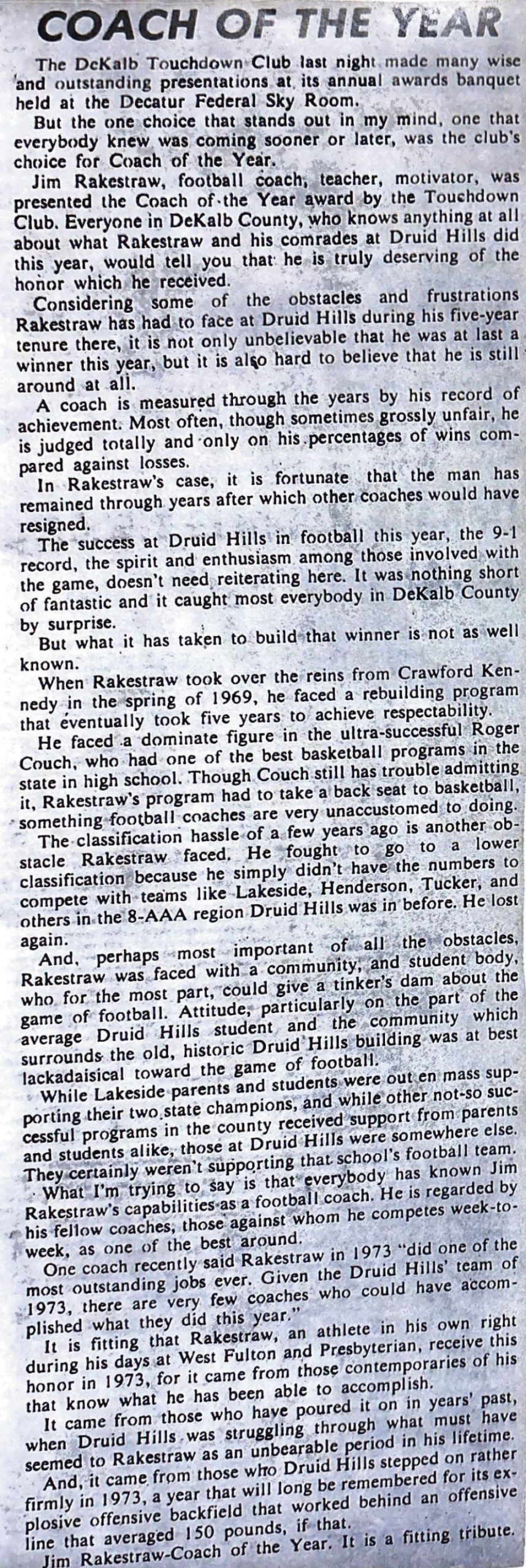

The DeKalb Touchdown Club last night made many wise and outstanding presentations at its annual awards banquet held at the Decatur Federal Sky Room.
But the one choice that stands out in many minds, one that everybody knew was coming sooner or later, was the club’s choice for Coach of the Year.
Jim Rakestraw, football coach, teacher, motivator, was presented the Coach of the Year award by the Touchdown Club. Everyone in DeKalb County who knows anything at all about what Rakestraw and his comrades at Druid Hills did this year would tell you that he is truly deserving of the honor which he received.
Considering some of the obstacles and frustrations Rakestraw has had to face at Druid Hills during his five-year tenure there, it is not only unbelievable that he was a last winner this year, but it is also hard to believe that he is still around at all.
A coach is measured through the years by his record of achievement. Most often, though sometimes grossly unfair, he is judged totally and only on his percentages of wins compared against losses.
In Rakestraw’s case, it is fortunate that the man has remained through years after which other coaches would have resigned.
The success at Druid Hills in football this year, the 9-1 record, the spirit and enthusiasm among those involved with the game, doesn’t need reiterating here. It was nothing short of fantastic and it caught most everybody in DeKalb County by surprise.
But what it has taken to build that winner is not as well known.
When Rakestraw took over the reins from Crawford Kennedy in the spring of 1969, he faced a rebuilding program that eventually took five years to achieve respectability.
He faced a dominate figure in the ultra-successful Roger Couch, who had one of the best basketball programs in the state in high school. Though Couch still has trouble admitting it, Rakestraw’s program had to take a back seat to basketball, something football coaches are very unaccustomed to doing.
The classification hassle of a few years ago is another obstacle Rakestraw faced. He fought to go to a lower classification because he simply didn’t have the numbers to compete with teams like Lakeside, Henderson, Tucker, and others in the 8-AAA region Druid Hills was in before. He lost again.
And, perhaps most important of all the obstacles, Rakestraw was faced with a community, and student body, who for the most part, could give a tinker’s dam about the game of football. Attitude, particularly on the part of the average Druid Hills student and the community which surrounds the old, historic Druid Hills building was at best lackadaisical toward the game of football.
While Lakeside parents and students were out en mass supporting their two state champions, and while other not-so-successful programs in the county received support from parents and students alike, those at Druid Hills were somewhere else. They certainly weren’t supporting that school’s football team.
What I’m trying to say is that everybody has known Jim Rakestraw’s capabilities as a football coach. He is regarded by his fellow coaches, those against whom he competes week-to-week, as one of the best around.
One coach recently said Rakestraw in 1973 “did one of the most outstanding jobs ever. Given the Druid Hills team of 1973, there are very few coaches who could have accomplished what they did this year.”
It is fitting that Rakestraw, an athlete in his own right during his days at West Fulton and Presbyterian, received this honor in 1973, for it came from those contemporaries of his that know what he has been able to accomplish.
It came from those who have poured it on in years past, when Druid Hills was struggling through what must have seemed to Rakestraw as an unbearable period in his lifetime.
And it came from those who Druid Hills stepped on rather firmly in 1973, a year that will long be remembered for its explosive offensive backfield that worked behind an offensive line that averaged 150 pounds, if that.
Jim Rakestraw — Coach of the Year. It is a fitting tribute.